Floodwater can turn a manageable property incident into a safety and structural emergency within hours. Standing water creates slip hazards, damages finishes and contents, conceals electrical risks, and increases the chance of microbial growth as porous materials remain saturated.
Emergency Flood Restoration generally means the rapid assessment, extraction, drying, cleaning, and stabilization of a home or business after flooding or a major water loss. The right response depends on where the water came from, how long it has been present, and which building materials it has reached.
For Lafayette property owners, the priority is not simply removing visible water. It is controlling the source, protecting occupants, locating hidden moisture, and creating reliable records for repairs and insurance. Restoration Logistics Lafayette can be contacted for a professional assessment once the property is safe to access.
Take Immediate Action Without Creating More Damage
Leave immediately if water is rising, the structure appears unstable, ceilings are sagging, or emergency officials have advised evacuation. Do not enter a flooded area where electrical components, outlets, appliances, or extension cords may be submerged.
A safety-first checklist includes:
- Avoid contact with floodwater, particularly when it may contain sewage, chemicals, fuel, or debris.
- Do not operate electrical equipment in wet areas or restore power if the electrical system may be compromised.
- Shut off water, gas, or electricity only if the shutoffs can be reached safely without entering hazardous water.
- Keep children, pets, and unprotected occupants away from affected rooms.
- Move unaffected belongings to a dry location only when doing so does not require walking through contaminated water.
- Photograph and video visible damage before substantial cleanup, provided documentation can be completed safely.
- Contact emergency services for immediate threats and notify the insurer about the loss.
DIY cleanup may be reasonable for a small, isolated clean-water spill that has not reached walls, insulation, wiring, or flooring systems. It is not appropriate for sewage, extensive standing water, ceiling damage, suspected electrical exposure, widespread saturation, or floodwater from outside the building.
Identify the Flood Source and Type of Water
The source affects health precautions, salvage decisions, drying methods, and coverage questions. A burst supply pipe, failed water heater, appliance leak, or HVAC condensate line is different from storm-driven water entering through doors, windows, foundations, or roofs.
Common emergency scenarios in the Lafayette area may include:
- Storm-driven water intrusion affecting roofs, exterior walls, or low areas around a structure.
- Basement or crawl-space flooding, where moisture can remain trapped beneath floors and inside insulation.
- Plumbing failures involving supply lines, drains, fixtures, or water heaters.
- Sewer backups, which can spread pathogens and require specialized containment and disinfection.
- Roof or foundation leaks that introduce water into ceilings, wall cavities, and finished spaces.
Restoration professionals commonly classify water by contamination level. Clean water may still cause substantial structural damage, while gray water can contain unsafe contaminants. Black water, including sewage or heavily contaminated floodwater, requires strict protective measures, controlled removal, and appropriate disposal. Floodwater may contain microorganisms, chemicals, and sharp debris, so visual appearance alone is not a reliable safety test.
What Emergency Flood Restoration Includes
A professional response normally follows a documented workflow:
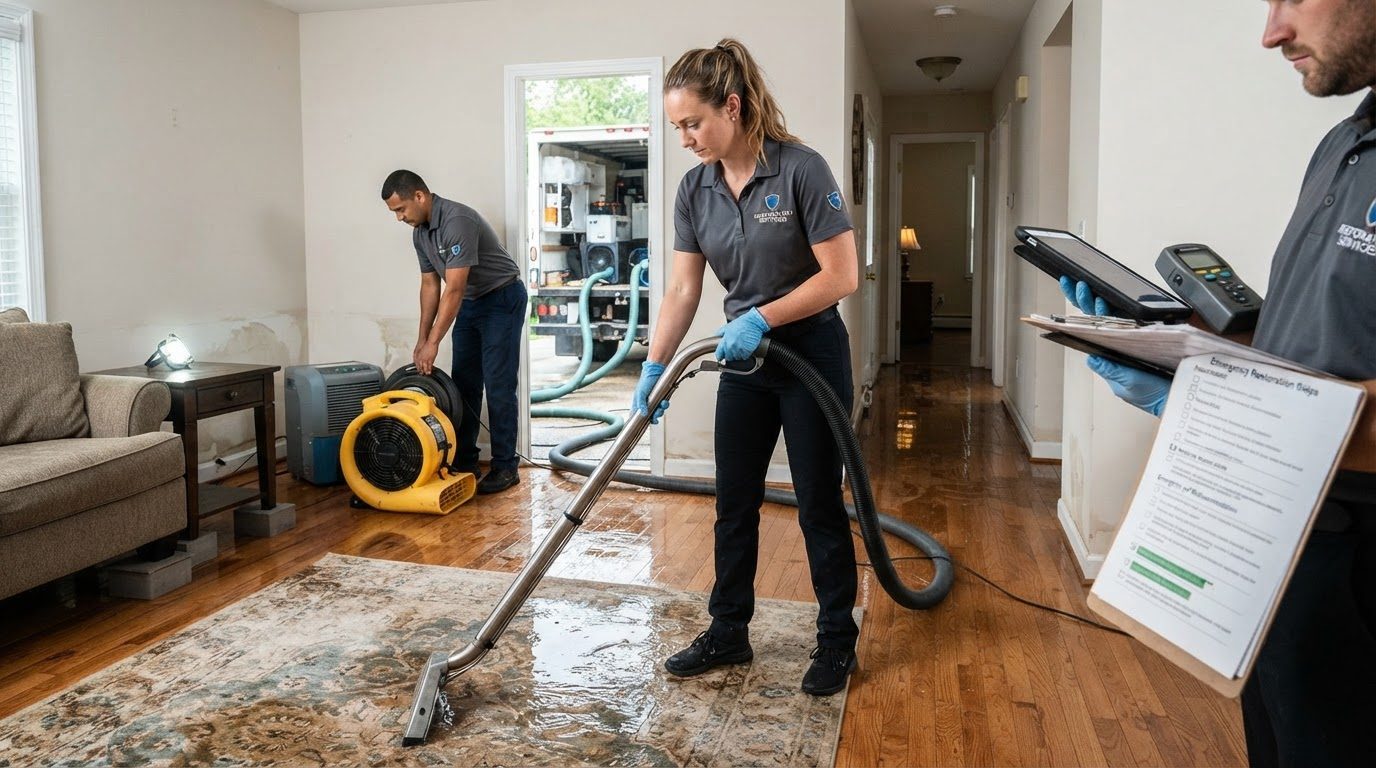
- Inspection and moisture assessment: Technicians identify the source, map affected areas, assess materials, and use moisture meters, thermal imaging, and penetrating probes to locate concealed saturation.
- Source control and stabilization: The active leak is stopped when possible. Technicians may protect contents, establish controlled access, remove immediate hazards, and recommend temporary roof or structural measures.
- Water extraction: Submersible pumps, truck-mounted or portable extractors, wet vacuums, and specialized tools remove standing water and embedded moisture.
- Selective demolition: Unsalvageable drywall, insulation, carpet pad, damaged cabinetry, and other porous materials may need removal to expose wet cavities and prevent prolonged contamination.
- Structural drying: Air movers increase evaporation while dehumidifiers remove moisture from the air. Technicians may create openings in walls or use cavity-drying systems when standard airflow cannot reach hidden spaces.
- Cleaning and treatment: Salvageable surfaces and contents may be cleaned, sanitized, deodorized, or treated according to the water category and material.
- Monitoring: Moisture readings, temperature, relative humidity, and equipment placement are tracked until affected materials reach appropriate drying targets.
- Repairs and reconstruction: Replacement drywall, flooring, trim, cabinets, paint, and other repairs follow mitigation, not the other way around.
Technicians evaluate walls, flooring, subfloors, cabinets, insulation, contents, and concealed cavities—not just visible puddles. Contents may be moved in place, protected, inventoried, packed out, cleaned, stored, or restored. Furniture and personal belongings should be documented before disposal whenever feasible.
Prompt drying helps reduce mold risk, but mold prevention is a consequence of effective water removal—not a substitute for extraction. If mold is already present, its scope and remediation method require separate evaluation.
Insurance, Documentation, and Restoration Costs
Whether insurance pays for water restoration depends on the policy, exclusions, endorsements, source, and cause of loss. Sudden internal water damage may be covered under some homeowners policies. External flooding often requires separate flood insurance. Sewer backup, groundwater intrusion, neglect, and maintenance-related losses may be treated differently.
Before major cleanup, document the following if it is safe:
- Photos and video of each affected room, material, and damaged possession.
- The apparent water source and the rooms reached.
- Furniture, appliances, electronics, documents, and other contents.
- Emergency purchases, temporary lodging, cleanup supplies, and contractor communications.
- Utility shutoff conditions and any visible structural or electrical concerns.
Ask the restoration contractor for an itemized scope, moisture records, equipment logs, photographs, daily notes, and disposal documentation. These records can help the owner and insurer distinguish mitigation from reconstruction.
Costs vary substantially. As broad U.S. planning ranges, minor extraction may cost several hundred dollars, while professional drying for a moderate loss commonly reaches roughly $1,000–$4,000. Extensive contamination, demolition, contents handling, or reconstruction can push projects beyond $10,000, with major losses reaching tens of thousands of dollars. Actual pricing depends on water category, square footage, accessibility, drying duration, equipment, labor, disposal, and finish repairs.
Contact the insurer promptly, but do not delay emergency mitigation when delay would allow additional damage. Policyholders generally have a duty to take reasonable steps to prevent worsening loss.
Choosing an Emergency Flood Restoration Team
Look for a company that offers genuine 24/7 emergency availability, clear arrival expectations, and written communication. Technicians should be trained in extraction, structural drying, sewage contamination, contents handling, and reconstruction. Ask whether the company follows IICRC standards and whether staff maintain relevant occupational-safety training, including OSHA practices for hazardous work. EPA guidance may also apply when microbial contamination or disinfectants are involved.
Useful evaluation criteria include:
- Commercial pumps, air movers, dehumidifiers, hygrometers, moisture meters, and thermal-imaging equipment.
- Experience with crawl spaces, wall cavities, hardwood, insulation, cabinetry, and contaminated water.
- Moisture maps, equipment logs, drying goals, photographs, and insurer-ready documentation.
- A clear explanation of what may be removed, what may be restored, and what remains the owner’s decision.
Before authorizing work, ask:
- What happens during the initial inspection?
- How will hidden moisture be located?
- Who monitors drying progress, and how often?
- Which materials may require removal?
- How will contents be protected, inventoried, and documented?
- Which work is mitigation, and which work is repair or reconstruction?
Mitigation stops active damage through extraction, stabilization, and drying. Restoration returns the structure to a functional condition through cleaning and material replacement. Reconstruction addresses finish work such as drywall, flooring, cabinets, trim, and paint. Keeping these phases distinct improves cost control and claim clarity.
Emergency Flood Restoration Questions
What is emergency water restoration?
It is the rapid assessment, water removal, structural drying, cleaning, stabilization, and, when necessary, repair of a property after a flood or water loss.
Can I perform flood cleanup myself?
Small clean-water incidents may be manageable if no electrical, structural, or hidden-moisture risks exist. Professionals should handle contaminated water, extensive saturation, sewage, electrical hazards, and structural damage.
How quickly should flood restoration begin?
Immediately. Porous materials can swell, delaminate, stain, or lose salvage value while wet. Delayed drying also increases the likelihood of odor and microbial growth.
Does standard homeowners insurance cover flood damage?
It depends on the policy and water source. Sudden internal leaks may be covered in some circumstances, while external flooding commonly requires a separate flood policy. Sewer backup and groundwater coverage may require endorsements or separate terms.
How long does restoration take?
Extraction may take hours, while structural drying often takes several days. Full restoration can take weeks when demolition, contents processing, permitting, or reconstruction is required. Water volume, contamination, materials, ventilation, weather, and repair scope all affect the timeline.
When floodwater threatens a property, prioritize life safety, document what can be documented without risk, and request a professional assessment as soon as the building can be safely accessed.